
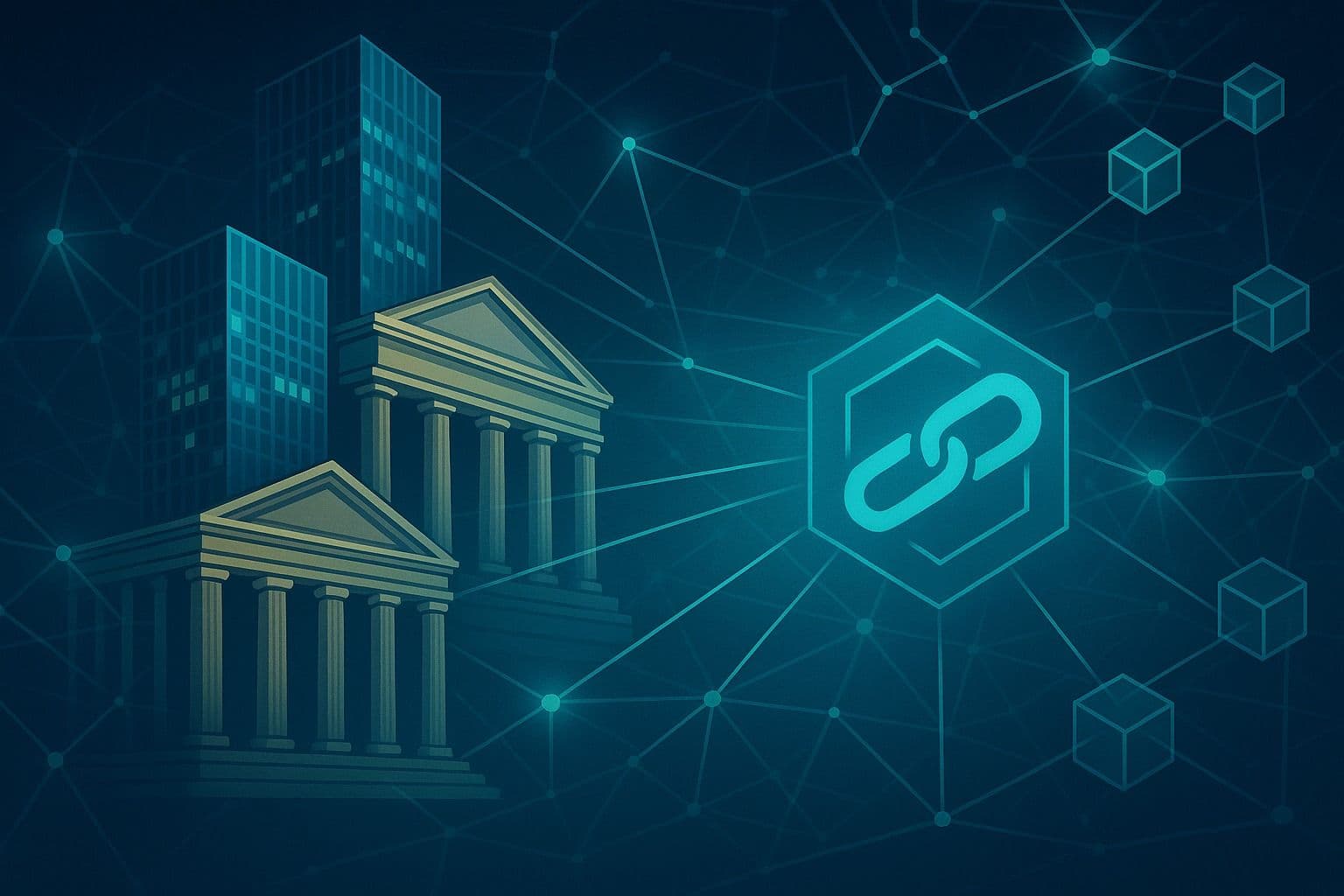
Leading Global Exchanges Begin Publishing Market Data Through Chainlink
Chainlink is accelerating its role as a core infrastructure provider for global financial markets. Several major institutions, including Deutsche Börse and the TSX Venture Exchange, have begun distributing regulated market data on-chain through Chainlink’s oracle technology. The development marks one of the clearest moves yet by traditional exchanges to connect their real-time financial information with blockchain applications.
Deutsche Börse, one of the world’s largest market operators, is now supplying real-time data from its equity, derivatives, and foreign exchange venues directly to blockchain networks. The TSX Venture Exchange has taken a similar step by making its market data available to decentralized ecosystems. These initiatives provide developers and institutions with authenticated information that can power tokenized assets, risk management tools, settlement products, and new forms of automated financial services.
Chainlink’s data infrastructure is designed to securely transport reliable information from centralized financial systems to smart contract platforms. The approach ensures that decentralized applications built for trading, settlement, and tokenization can use the same high-fidelity data that underpins traditional markets.
Industry analysts view the move as a significant milestone for the tokenization sector. Accurate and compliant market data is considered essential for institutions that are experimenting with on-chain representations of real-world assets, structured products, and market benchmarks. By supplying data across multiple blockchains, Chainlink supports an emerging environment where regulated markets and decentralized finance tools can interact with higher transparency and lower counterparty risk.
Mastercard and Chainlink Partner to Bring DeFi Access to Billions
Chainlink’s expansion is not limited to institutional datasets. The network is also supporting a new payments initiative that allows Mastercard’s global customer base, estimated at more than three billion cardholders, to purchase digital assets and interact with decentralized finance through familiar payment methods.
The system connects Mastercard’s payment networks with regulated fiat-to-crypto conversion services and liquidity from decentralized exchanges. Users can fund purchases with their existing payment cards and execute on-chain swaps through automated smart contract systems. The result is a streamlined user journey that lowers barriers to participating in decentralized markets.
The collaboration is being closely watched because it represents one of the largest attempts to connect mainstream financial infrastructure with blockchain-based liquidity pools. If widely adopted, it could accelerate retail access to digital assets and support broader engagement with decentralized applications.
Why Chainlink Has Become Central to Institutional Blockchain Strategy
The recent announcements reflect a broader trend across banks, exchanges, asset managers, and payment companies. Many of these institutions are prioritizing interoperability and data reliability as they experiment with tokenized instruments, settlement networks, and programmable financial products.
Chainlink’s value proposition rests on three pillars.
Reliable and Verified Data
Financial institutions require accurate information that meets compliance and audit standards. Chainlink’s oracle networks allow verified datasets to be delivered to blockchains without exposing internal systems.
Cross-Chain Compatibility
Chainlink supports many public and private blockchain environments. This allows institutions to test new models without being tied to a single network or vendor.
Alignment With Regulatory Expectations
Tokenization and DeFi integration cannot scale without strong data controls. Chainlink’s structure mirrors many of the data integrity requirements that existing financial entities already follow.
Opportunities and Considerations
Although momentum is building, the path toward full adoption has several challenges. Regulatory frameworks for tokenized assets are still evolving. Institutions must also evaluate operational risks related to moving sensitive market data across distributed systems. User adoption of DeFi services through payment networks will depend on ease of use and perceived security.
Even with these considerations, the direction of travel is clear. Institutions are adopting blockchain not as a speculative tool but as an infrastructure layer for settlement, data distribution, and programmable financial products. Chainlink’s growing footprint across exchanges and payment networks highlights its strategic position in this shift.
The Outlook for 2025 and Beyond
The combination of institutional market data, payment-network access, and cross-chain interoperability suggests that financial systems are entering a more integrated phase. Traditional exchanges are beginning to treat blockchain as a legitimate distribution channel for regulated information. Payment companies are exploring ways to give consumers easier access to digital markets. Developers are building financial tools that can operate across asset classes, networks, and jurisdictions.
Chainlink is positioned at the center of these developments. With major exchanges publishing data on-chain and Mastercard enabling access to decentralized liquidity, the foundation is being laid for a financial landscape where public markets, digital assets, and programmable finance coexist within a single interoperable framework.
If adoption continues on this trajectory, the coming years could see the largest shift in financial infrastructure since the rise of electronic trading. The institutions taking these early steps signal that blockchain integration is no longer experimental. It is becoming a core component of future market architecture.