
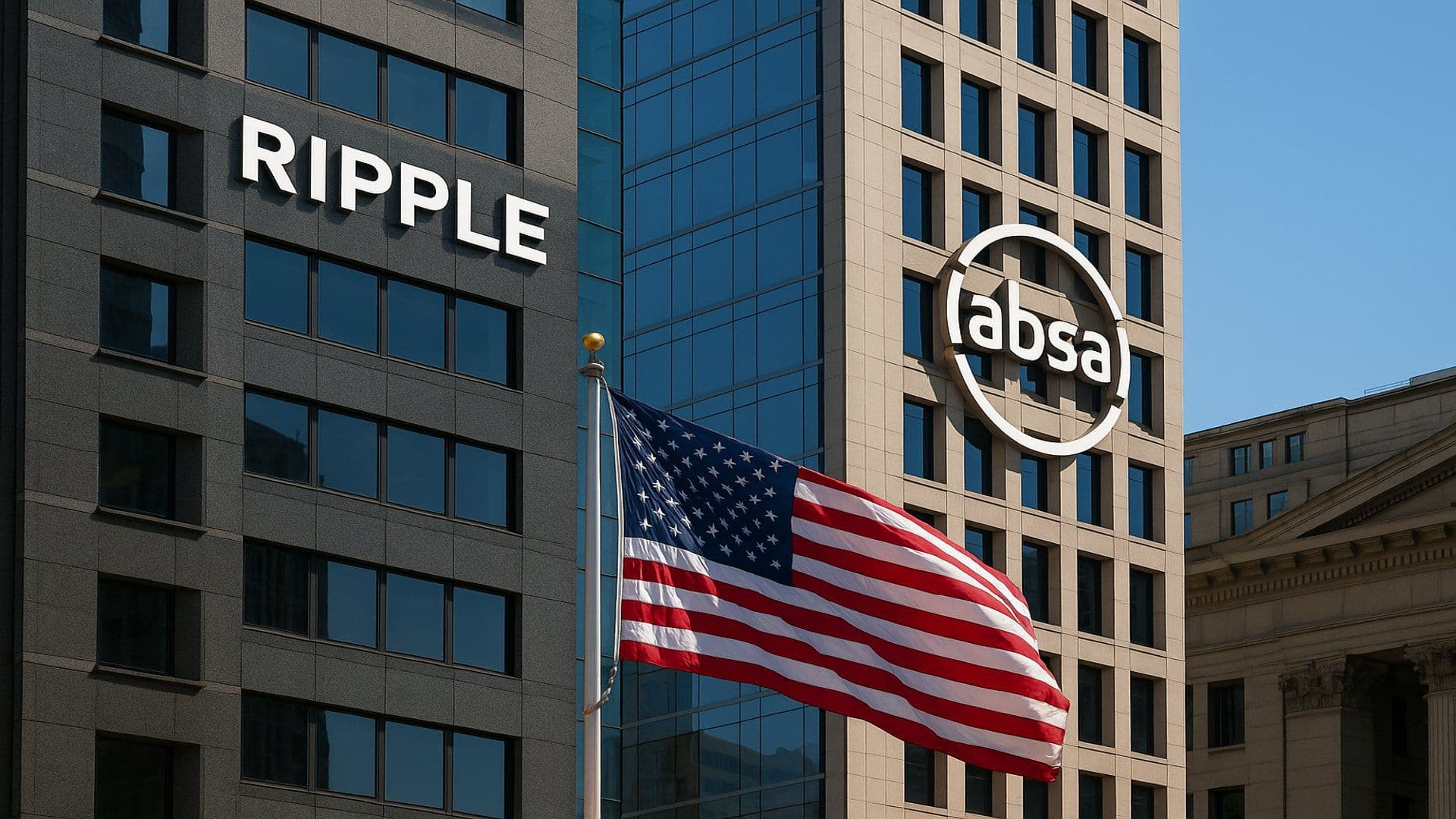
Ripple is reshaping its global narrative through a series of strategic moves that tie together banking partnerships, regulatory advances, and technical innovation. The company’s expanding footprint now stretches from Africa’s financial corridors to Europe’s regulatory heart — all while U.S. investors anticipate the next big ETF approval.
Absa Alliance Marks Ripple’s African Breakthrough
Ripple has struck a significant partnership with South Africa’s Absa Bank to deliver institutional-grade digital asset custody. The collaboration marks Ripple’s entry into Africa’s regulated finance sector, offering banks secure management of tokenized assets and cryptocurrencies.
Reece Merrick, Ripple’s Managing Director for the Middle East & Africa, described the partnership as a “turning point for African institutions embracing digital value.”
Absa’s Head of Digital Custody, Robyn Lawson, said the partnership places Absa “at the forefront of compliant digital asset integration.”
This alliance arrives at a critical moment for Africa’s fintech evolution, where financial institutions are increasingly turning to blockchain to strengthen cross-border liquidity and digital payments. Ripple’s technology is now positioned as a gateway between traditional banking and decentralized finance across the continent.
Luxembourg: The European Key to Ripple’s Regulatory Puzzle
Ripple’s next strategic move is unfolding in Europe. The company is advancing toward regulatory approval in Luxembourg under the EU’s Markets in Crypto-Assets (MiCA) framework — a law designed to harmonize digital asset oversight across all member states.
Chief Legal Officer Stuart Alderoty highlighted Luxembourg’s leadership in fostering digital innovation, calling it “the ideal environment for responsible crypto regulation.”
Ripple’s proposed entity, Ripple Payments Europe S.A., would serve as its operational hub, enabling licensed activity throughout the European Economic Area once approved.
Luxembourg’s financial sector, known for housing leading global institutions, could give Ripple a powerful advantage in serving both corporate and government partners seeking compliant blockchain solutions.
The $200K Challenge: Ripple Puts Its DeFi Protocol to the Test
In a move rarely seen from major fintech firms, Ripple has offered a $200,000 bounty to anyone capable of breaching its new XRP-based lending protocol — a bold statement about its confidence in security.
The company’s engineers believe public challenges like this build credibility and transparency around DeFi products, particularly for institutional partners wary of on-chain vulnerabilities.
Beyond the bounty, Ripple is expanding the XRP Ledger’s functionality with enhanced tokenization, on-chain lending, and integration of its RLUSD stablecoin. Together, these developments aim to establish XRPL as a trusted foundation for compliant decentralized finance.
ETF Speculation Turns into Realistic Expectation
Ripple’s leadership has reignited anticipation for a potential XRP exchange-traded fund. President Monica Long recently stated that approval odds are “very high this year,” following the success of Bitcoin and Ether ETFs.
CEO Brad Garlinghouse went further, suggesting an XRP ETF is “inevitable” as investor demand for regulated crypto exposure grows. Analysts estimate even minimal institutional allocation could drive billions in inflows once such a product is approved.
The biggest challenge remains the U.S. Securities and Exchange Commission, whose caution toward new ETF products could delay timing. Still, Ripple’s strengthened global framework — from custody operations to compliance credentials — gives it a stronger foundation than ever.
Sentiment Metrics Show Confidence Despite Price Swings
Market analysts tracking Ripple’s narrative identify several key drivers behind its current momentum:
- Institutional Momentum (45%) – Global banking partnerships enhance XRP’s legitimacy.
- Community Optimism (30%) – Positive sentiment remains strong across social platforms.
- Tech Evolution (15%) – XRPL’s lending and tokenization growth broadens utility.
- Market Caution (5%) – Price volatility persists, with XRP trading near $2.43 after a 14% weekly dip.
- Regulatory Debate (5%) – Ongoing scrutiny around centralization keeps pressure on Ripple’s transparency.
Despite short-term corrections, XRP’s one-year gain of over 340 percent has kept it among the best-performing large-cap digital assets.
The Road Ahead: What Could Reshape Ripple’s Trajectory
- Luxembourg Licensing Decision: Approval under MiCA could open EU-wide operations.
- Absa Integration Timeline: The rollout of live custody services will test institutional demand.
- ETF Filings Progress: Any official acknowledgment from U.S. regulators could trigger a market rally.
- DeFi Adoption Metrics: Growth in RLUSD and XRPL lending volumes will measure real traction.
- Security Audit Outcomes: The $200K challenge results will influence institutional trust in Ripple’s DeFi model.
Ripple’s expansion strategy reflects a rare blend of ambition and execution — bridging emerging and mature markets, private banking and decentralized innovation, speculation and structure. If these efforts align, XRP’s next rally may come not from hype, but from genuine financial infrastructure taking shape worldwide.