
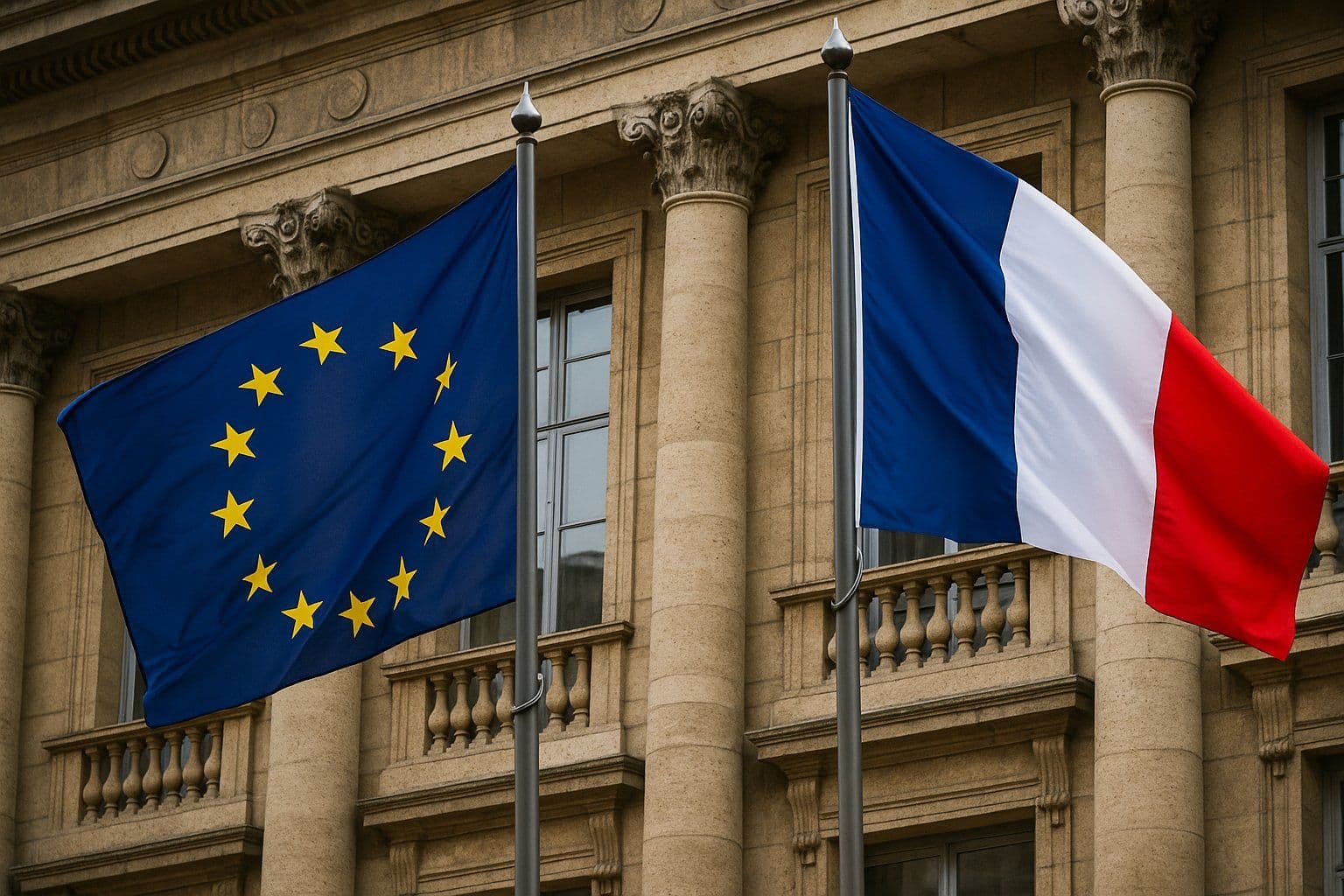
Paris Leads the Call for Centralized Oversight
France’s financial authorities are calling for a European-wide crypto supervisor to replace the patchwork of national regulators managing digital asset markets. The proposal would give the European Securities and Markets Authority (ESMA) direct control over licensing and enforcement for exchanges, stablecoin issuers, and tokenized funds.
At a recent finance summit in Brussels, French officials warned that inconsistent implementation of MiCA — the EU’s landmark crypto regulation — risks fragmenting compliance standards and driving business outside Europe.
“Europe can’t afford twenty-seven versions of crypto supervision,” said AMF President Marie-Anne Barbat-Layani. “A unified framework under ESMA would protect investors and strengthen trust.”
Analysts covering the EU regulation landscape say France’s move signals a strategic bid to make Paris the political center of European digital-asset policy.
Why France Wants ESMA in Charge
Under MiCA, national regulators currently handle licensing and enforcement, while ESMA coordinates oversight. But France argues that this approach creates loopholes and allows regulatory arbitrage — where firms pick countries with lighter enforcement.
A centralized ESMA mandate would streamline compliance and ensure equal standards for exchanges operating across borders. Proponents say this would also simplify cross-listing of tokenized assets between markets, potentially boosting liquidity.
Critics, however, warn that handing full power to ESMA could slow innovation by adding bureaucratic layers and reducing local flexibility. Germany and several Nordic countries reportedly prefer to retain their national authority structures, citing domestic accountability.
“This is about who gets to set the rules for the future of finance,” said a Brussels-based policy consultant. “The tension between national control and EU centralization is playing out in real time.”
Reports from regulation and policy news indicate that a formal proposal could be introduced by early next year, though significant political negotiation remains ahead.
MiCA Implementation Tensions
MiCA officially entered into force this year, marking the EU’s most ambitious crypto legislation to date. However, its rollout has revealed sharp contrasts between member states.
France and the Netherlands have been among the fastest to align with MiCA’s licensing standards, while smaller nations have lagged. The divergence has raised concerns that uneven application could disadvantage compliant firms.
Industry leaders following blockchain regulation updates say the issue is not whether the rules exist, but how consistently they are applied.
“If ESMA coordinates directly, you remove ambiguity,” one exchange executive said. “But if every country tweaks its interpretation, you lose the single market advantage that makes the EU attractive.”
Industry Reaction Across Europe
Crypto exchanges and fintech associations have largely welcomed the proposal. A joint statement from several European blockchain advocacy groups praised the idea as “a necessary step toward regulatory maturity.”
Institutional investors also view centralized supervision as a credibility boost. “Clear and unified oversight would help unlock institutional adoption,” said a portfolio strategist at a Paris-based digital asset fund. “Markets crave certainty.”
However, critics within member states warn that a full ESMA takeover could concentrate too much power in one institution. Some fear it could replicate the early years of the European Central Bank, when policy centralization created tension among national regulators.
Still, the consensus among analysts is that Europe is inching toward a more coordinated regulatory structure, even if ESMA’s final mandate ends up being partial.
The Broader European Context
The timing of France’s proposal is strategic. Global regulators are tightening scrutiny, and the EU wants to position itself as a balanced model — encouraging innovation while maintaining stability.
With U.S. lawmakers still divided on crypto policy, Europe sees an opportunity to lead on international standards. Discussions at the OECD and G20 have already highlighted MiCA as a potential global blueprint for digital asset regulation.
Observers across the global regulation debate believe that centralizing power under ESMA could accelerate Europe’s influence in shaping cross-border policy.
What a Unified Authority Would Mean for the Market
If ESMA gains direct oversight, exchanges would likely face uniform licensing and compliance audits across all 27 EU states. That could eliminate “passporting” loopholes but also increase operational costs for smaller startups.
For investors, however, the benefits could be substantial: greater transparency, consistent disclosures, and fewer jurisdictional risks. Analysts also note that institutional capital — long hesitant to enter fragmented European markets — could find renewed confidence in a single supervisory model.
“Regulation isn’t the enemy of innovation,” said one French official. “It’s the foundation that makes innovation scalable.”
Why This Debate Matters for Europe’s Crypto Future
- France is leading efforts to give ESMA full regulatory authority over crypto markets.
- A unified system could close compliance gaps between EU member states.
- Critics warn of over-centralization and reduced local flexibility.
- Industry groups support the proposal as a step toward institutional credibility.
- The outcome could determine whether Europe leads or follows in the global digital-asset race.