
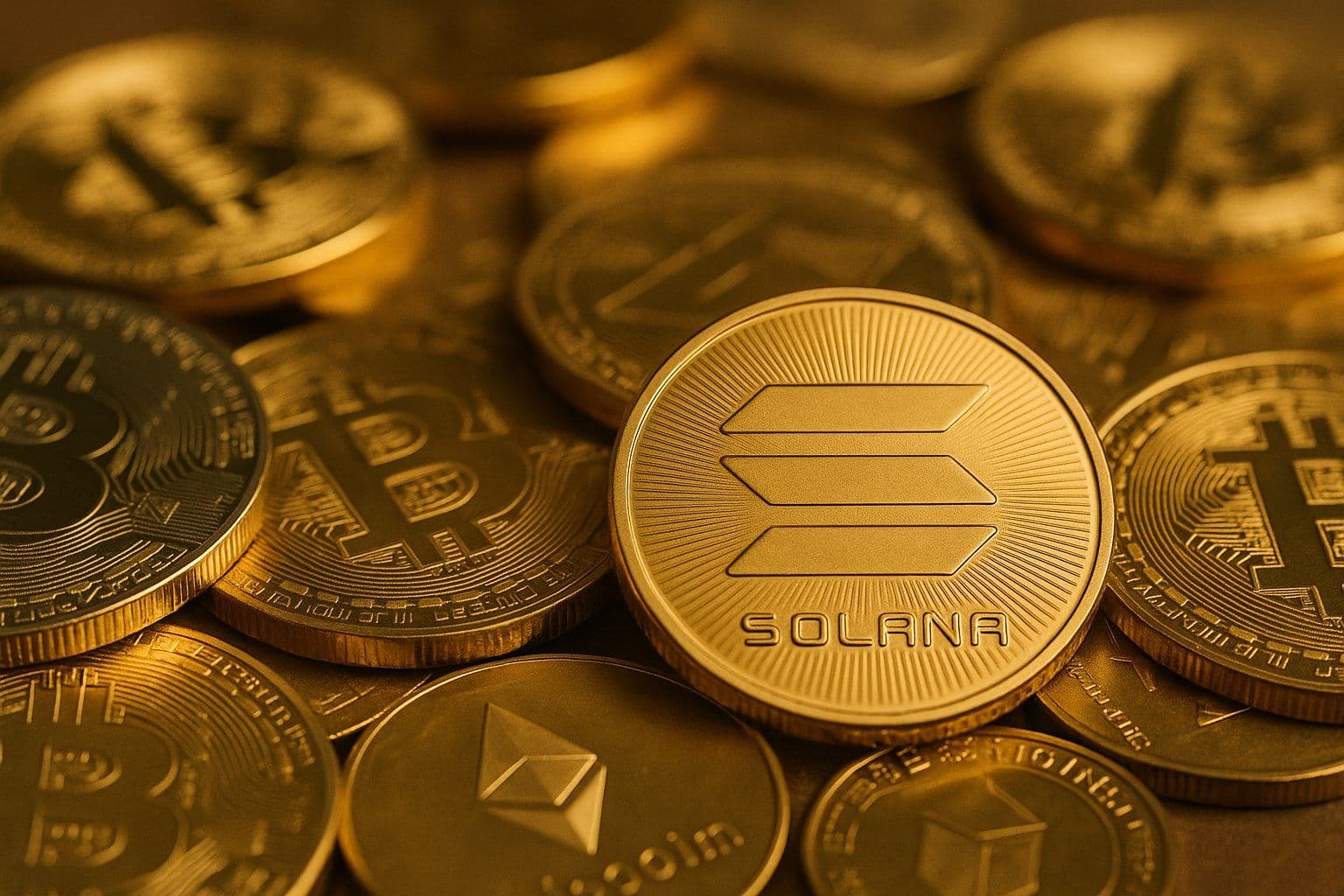
Solana Is Entering a New Phase of Real Demand
Solana is experiencing one of its strongest adoption waves to date, driven by simultaneous momentum across powerful growth vectors: DeFi liquidity, venture investment, stablecoin expansion and institutional alignment. The most symbolic moment arrived when Uniswap officially integrated Solana trading into its interface. It marks the first time the world’s most recognized decentralized exchange interface has integrated a non-EVM chain at native liquidity depth through Solana routing. This is not a wrapped-asset bridge experiment. It is a direct validation of Solana as a first-class execution environment.
Uniswap’s expansion to Solana immediately exposes the network to a user base accustomed to EVM infrastructure but eager for lower latency and significantly cheaper transaction finality. The integration unlocks access to approximately 11 billion dollars in active Solana DeFi liquidity and gives Solana equivalent front-end visibility to Ethereum for the first time at a retail user interface level.
a16z Signals Institutional Conviction With 50 Million Dollar Jito Investment
Silicon Valley has officially doubled down. Andreessen Horowitz’s crypto arm allocated 50 million dollars to Jito, which powers Solana’s block optimization, staking economics, and validator rewards infrastructure. The round signals to institutional allocators that Solana’s validator and execution layer is now viewed as critical infrastructure rather than an experimental chain.
Jito is positioned at the heart of Solana’s block assembly and staking supply chain. Its role is equivalent to optimizing high-frequency execution structure on traditional exchanges. With this funding, Solana is not merely gaining capital. It is gaining a Wall Street-grade infrastructure enhancement designed to improve execution integrity, validator yield, and network competitiveness against centralized market-making systems.
Stablecoin Explosion Highlights Real Economic Utility
Perhaps the most powerful signal of organic product-market fit is stablecoin liquidity. Solana stablecoin supply has exploded from roughly 5 billion dollars to over 17 billion dollars in under nine months. Unlike speculative token rallies, stablecoin growth reflects real transactional utility — payments, remittances, automated liquidity, market-making collateral and settlement flows.
USDC dominates this expansion, but future growth is expected to diversify as new financial institutions deploy their own regulated stablecoins directly onto Solana’s rails. That evolution matters. Stablecoins are not just transactional lubricant. They are economic energy. Rising velocity and depth of stablecoin float correlates directly to the potential size of Solana’s financial system.
Institutional Eyes Now Target the Solana Trade
Solana is transitioning from a high-performance chain to a liquidity engine with institutional credibility. European regulated products have begun accumulating Solana staking exposure. A growing number of corporate treasury desks are openly exploring Solana-based settlements and stablecoin use cases. Macro strategists now argue that if Solana’s transaction layer continues to absorb real financial traffic, it may begin to attract rotation capital away from Bitcoin as performance-driven allocation preferences shift.
The positioning is not Bitcoin versus Solana in a zero-sum way. It is Bitcoin as the macro asset, Solana as the execution and liquidity layer. For institutional desks that think in portfolios instead of narratives, this positioning is extremely attractive.
What to Watch Next
Adoption curve
Daily active addresses, DEX volumes and Uniswap-on-Solana routing share will determine if this is durable flow or short-term curiosity. Tools like Artemis, DeFiLlama and exchange dashboards will show the inflection very quickly if usage turns persistent.
Stablecoin runway
If stablecoin supply holds above 17 billion dollars and velocity accelerates rather than stagnates, Solana’s credit, payments and market-making frameworks will be strong enough to power institutional scale products. Solana data platforms such as SolanaFloor already reflect rising user liquidity density.
Jito execution data
The impact of the 50 million dollar raise will be measured in block assembly performance, validator tooling upgrades and improvements in slippage, failed transaction rates and MEV fairness. Institutional desks are watching for execution standards that resemble exchange-grade reliability.
Policy and product direction
New staking ETPs, enterprise treasury announcements and bank-issued stablecoin pilots will confirm that Solana is now being treated not just as a developer ecosystem but as financial infrastructure. If these conditions align, capital rotation beyond Bitcoin becomes a structured probability rather than a speculative thesis.
The Strategic Reality
Solana has arrived at a point where technical speed, liquidity density, institutional investment and stablecoin settlement are converging simultaneously. This is no longer a narrative-driven rally. It is a systems-level escalation of network relevance. If these signals continue through Q4, the conversation will not be whether Solana deserves institutional flow — but how much of it the network can absorb in time.