
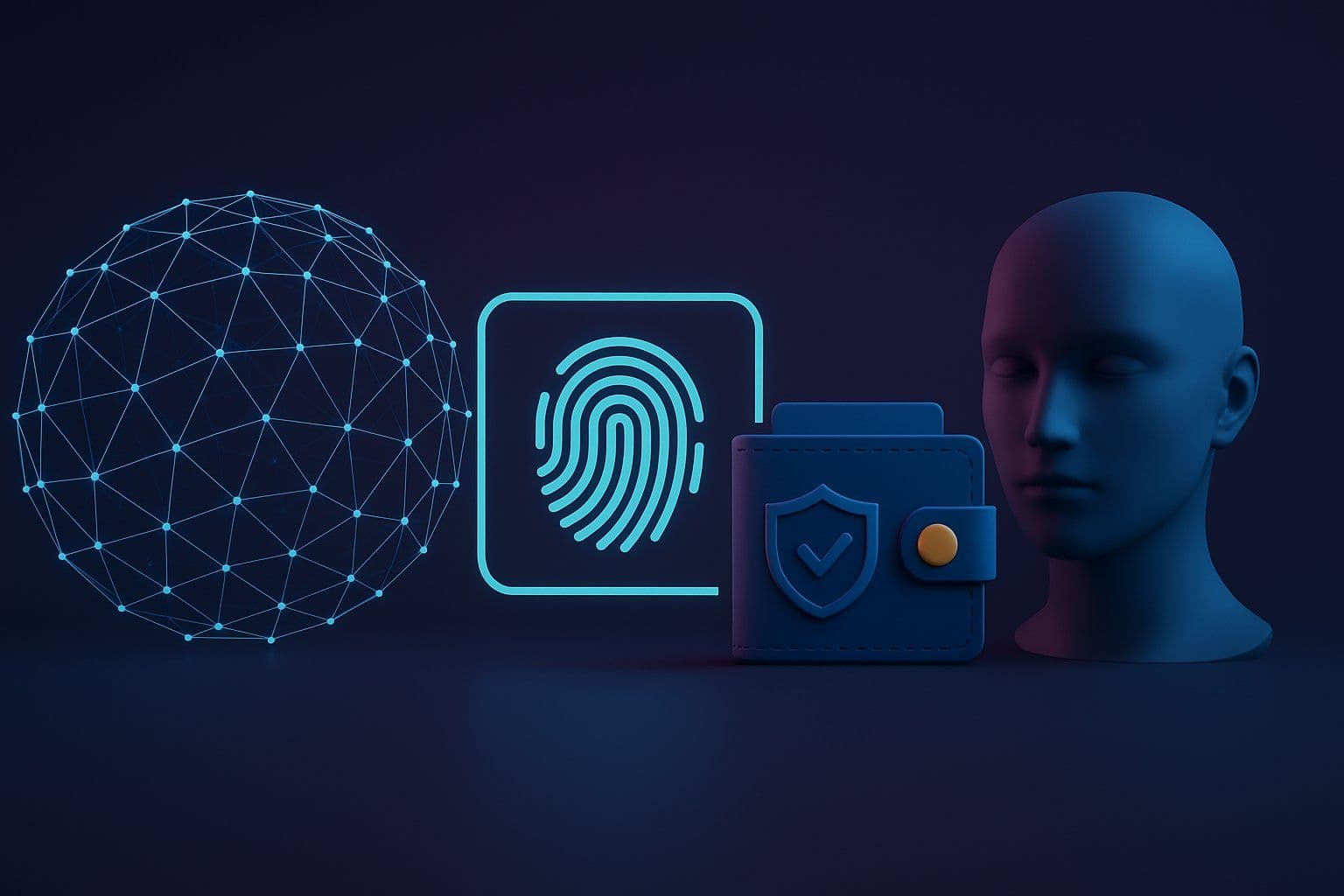
For most of the modern internet, users have relied on platforms to define, verify and protect their digital identities. A Google login, an Apple ID or a Facebook account has served as the key that opens access to everything from banking apps to news platforms to entertainment streaming services. These platforms hold the power to approve or deny access at will. The user, in reality, does not truly own anything — their identity, their access and even their history can vanish if a centralized authority decides to revoke it.
A profound transition is about to begin. A shift from platform-issued identity to user-owned identity. A shift from passwords and email verification to biometric authentication and wallet-based access. A shift from interfaces that users manually navigate to AI agents that act on the user’s behalf. This next phase of the internet is not simply blockchain powered. It is human sovereignty powered. Ownership, authentication and intelligence will merge into a seamless digital identity layer that is no longer controlled from above. It is carried by the individual, verified on-chain and extended through autonomous AI.
This transformation has already started quietly across the infrastructure layer of the next internet. It will not be noticed first by casual observers. It is being built into wallets, identity protocols, biometric access engines and intent-based execution systems. Once it reaches consumer applications at scale, it will feel immediate — not because it arrived suddenly, but because its foundation was laid silently until ready.
From Platform Control to Identity Sovereignty
Today, identity belongs to centralized providers. A user may have accounts on Netflix, PayPal, Binance, Spotify or Instagram, yet none of these identities are truly theirs. Their account access can be limited, altered or removed without consent. Their private information is stored on servers they do not control. Their digital presence is always granted — never owned.
Web3 identity inverts that structure completely. In the emerging model, identity originates from the user. It is stored within a wallet, verified cryptographically and authenticated across platforms without needing to request permission from any intermediary. This is not speculative. Wallet-based authentication exists today for thousands of decentralized applications. It is already beginning to move toward mainstream products.
In this new structure, the wallet is no longer just a financial instrument. It becomes the source of truth. It carries not only value, but permission, reputation, credentials and proof of humanity. Instead of logging in with email and password, users will connect directly with identity they already own. Authentication is reduced to a wallet signature, which can be authorized, revoked or compartmentalized by the user alone.
Biometric Authentication Will Make It Natural
One of the biggest reasons mass adoption of Web3 slowed was user friction. Seed phrases, private keys and non-recoverable accounts were not built for the average person. That barrier is disappearing quickly. With account abstraction and biometric security, users will access Web3 and identity ownership without ever seeing a private key. They will unlock their identity the same way they unlock their phone. Fingerprint. Face scan. Secure behavior confirmation. Nothing more.
This is the crucial turning point many people underestimate. Once wallets feel just as simple as unlocking an iPhone, and significantly safer than using a password, everything changes. The user is no longer forced into the platform’s identity system. They carry their own. With biometrics and recovery built in at the protocol level, both convenience and sovereignty advance together instead of conflicting. This is what unlocks mass adoption.
AI Agents Will Take Over the Interface Layer
The next major leap is even greater. It will not just be identity that becomes user-owned. It will be decision-making. Users will not manually interact with contracts and platforms. They will assign AI agents inside their wallets to act on the user’s behalf. These agents will hold narrowly defined permissions — such as optimizing returns, reallocating risk or executing trades under specific conditions — and they will operate continuously with no delay.
Instead of logging into an app, selecting an asset and manually placing a trade, a user might instruct an AI agent inside their wallet to rebalance exposure across stable assets every time volatility exceeds a defined threshold. Instead of browsing for subscription renewals, they may instruct their agent to maintain only active services and cancel any unused over a defined period. The agent becomes the user’s representative — not a tool, but an executor of intent.
This fundamentally transforms the structure of digital interaction. The user will not navigate and approve every micro action manually. They will set high-level preferences and constraints. The agent will interpret live data and act accordingly. This is not a theoretical concept. It is already being tested by leading DeFi protocols and AI research groups. Early versions are functioning now in controlled environments.
Three Pillars Are Converging into One Reality
The coming shift is defined by the fusion of identity, authentication and intelligence.
• The wallet becomes the root identity, replacing the login system entirely.
• Biometrics become the natural method of access, replacing passwords forever.
• AI agents replace manual interfaces, executing actions under user-defined intent.
The result is a digital world that is no longer controlled by platforms. Users do not ask platforms for permission. They verify themselves with cryptographic proof. They do not manually submit every instruction. They assign intelligent agents with access boundaries. They do not fear account loss. Their identity exists independent of any company or server.
The consequences are transformative. Platforms are no longer the gatekeepers. Applications must adapt to user-owned identity by default. Data power shifts from corporate silos to encrypted personal vaults. Economic activity becomes agent-driven rather than human-driven at the execution layer. The digital world decentralizes — not only financially, but cognitively, legally and operationally.
Not Just a Technological Shift — a Power Conflict
This is not only about better software. It is about control. The current internet architecture allows corporations and governments to observe, censor, filter or monetize every identity event. The next internet reduces that control. A wallet-based identity system cannot be silently revoked by corporate moderation. AI agents cannot be quietly blocked at the interface layer. Biometric authentication eliminates the need for centralized credential storage altogether.
This will challenge existing power structures. It is not merely innovation. It is rebellion by architecture. And like every prior major paradigm shift, it will not be universally welcomed. Legacy platforms will attempt to integrate Web3 identity under restrictive models. Some governments will push for selective access or data mirroring. Centralized versions of digital identity will be marketed as secure upgrades. But none will offer true sovereignty. True sovereignty requires no third-party approval to exist.
A Quiet Revolution Already in Motion
The most important detail is that this future is not distant. It is here now in its first form. Wallet-based authentication is already standard across Web3. Account abstraction is making seedless wallets a reality. Biometrics are being merged with wallets to eliminate manual key handling. AI agents capable of live on-chain execution are now in public testing environments. Developers are no longer guessing. They are building the replacement for the login system in real time.
Most users will only realize this when it reaches consumer applications without warning. They will open an app and see no login screen. They will unlock with fingerprint and instantly be inside their sovereign identity workspace. They will issue a command to their AI agent and financial execution will begin without delay. That moment will feel instant to the world. But the foundation is already complete. Adoption, not invention, is now the only remaining step.
The Digital World Will Soon Be User-Rooted, Not Platform-Rooted
In the next era of the internet, identity will begin from the user. Power will begin in the wallet. Trust will begin in math, not in corporate permission. Authentication will begin with the body, not with passwords. Execution will begin with autonomous instruction, not with manual navigation. The internet will evolve from an access-rental system to an ownership-verification system. From platform ownership to user sovereignty.
The biggest miscalculation people are making is believing this is far away. It is not. The shift has already started underneath the surface. The first wave of people and platforms who recognize it and adapt will not just survive in the new system. They will define it.